Learn how to choose the right tile adhesive for vitrified and large-format tiles. Understand adhesive grades, substrate preparation, back-buttering, coverage, and installation tips.
How to Choose the Right Tile Adhesive for Vitrified & Large Format Tiles
Vitrified and large-format tiles have become increasingly popular in modern residential, commercial, and architectural projects. Their elegant appearance, low porosity, durability and wide range of designs make them a preferred choice for floors and walls.
However, achieving a strong and long-lasting tile installation depends on more than selecting a good-quality tile. Choosing the right tile adhesive is equally important.
Why does adhesive selection matter?
Vitrified tiles have a dense, low-porosity surface, while large-format tiles require careful attention to adhesive coverage, substrate preparation, and installation technique.
Unlike conventional ceramic tiles, vitrified tiles have a dense, low-porosity surface, which can make bonding more challenging. Large-format tiles also require careful adhesive selection and proper installation techniques because of their size, weight and increased surface area.
In this guide, we explain the key factors to consider when selecting a tile adhesive for vitrified and large-format tiles, and how the right adhesive can contribute to a reliable, professional installation.
Why Is the Right Tile Adhesive Important?
Tile adhesive acts as the bonding layer between the tile and the substrate. A properly selected adhesive helps provide consistent contact and adhesion when the product is mixed and applied according to the manufacturer's instructions. The right adhesive should be selected based on several factors, including:
- Type of tile
- Tile size and format
- Substrate condition
- Interior or exterior application
- Floor or wall installation
- Moisture and temperature exposure
- Expected traffic and service conditions
- Required working and open time
- Required slip resistance and deformability
Professional Tip: Using an adhesive simply because it is inexpensive or readily available may not be the best approach. The adhesive should be suitable for the specific application.
What Makes Vitrified Tiles Different?
Vitrified tiles are manufactured to have a dense structure and very low water absorption compared with many conventional ceramic tiles. This gives them desirable properties such as durability, low porosity and resistance to moisture.
However, their dense surface also means that adhesive selection becomes particularly important.
A tile adhesive intended for vitrified or other low-porosity tiles should be selected according to the manufacturer's technical specifications and the requirements of the installation.
Important: For professional tile fixing, always check the adhesive's recommended applications before beginning work.
Why Do Large-Format Tiles Require Extra Attention?
Large-format tiles offer a clean, contemporary appearance with fewer visible joints. They are commonly used in living rooms, offices, hotels, commercial spaces, bathrooms, and other modern interiors. However, larger tiles can present additional installation challenges.
A large-format tile:
- Has a greater surface area.
- Can be heavier and more difficult to handle.
- Requires proper adhesive coverage.
- Can be more sensitive to uneven substrates.
- May require back-buttering depending on the tile and installation requirements.
- Requires careful alignment and handling.
- Can be affected by movement within the substrate or installation system.
For these reasons, selecting the appropriate adhesive is only one part of the process. Correct substrate preparation, adhesive application, coverage, and installation technique are equally important.
5 Important Factors When Choosing Tile Adhesive
1. Consider the Tile Type
Start by identifying the type of tile you are installing. Common tile types include:
- Ceramic tiles
- Vitrified tiles
- Porcelain tiles
- Large-format tiles
- Natural stone
- Glass mosaic
- Other specialty tiles
Different tiles can have different absorption characteristics and installation requirements. Always select an adhesive recommended for the particular tile type.
For vitrified tiles, look for an adhesive whose technical documentation specifically indicates suitability for the intended vitrified or low-porosity tile application.
2. Consider the Tile Size
Tile size is another important factor. A standard-sized tile and a large-format tile can have significantly different installation requirements.
As tile dimensions increase, achieving adequate and uniform adhesive coverage becomes increasingly important.
Tile Length × Tile Width + Tile Thickness + Application Location
For example, a 600 × 600 mm tile and a 600 × 1200 mm tile may require different installation considerations even when they are made from similar materials.
For very large tiles and slabs, follow the adhesive manufacturer's recommendations and the applicable installation guidance for the project.
3. Check the Substrate
The adhesive cannot compensate for an unsuitable substrate. The surface should generally be:
- Sound and structurally stable
- Clean
- Free from dust and loose particles
- Free from oil, grease and other contaminants
- Suitably cured
- Appropriately prepared for the selected adhesive
Common substrates can include cement-based screeds, concrete and cement plaster, subject to the adhesive manufacturer's recommendations.
If the substrate is uneven, weak or contaminated, simply using a higher-grade adhesive may not solve the underlying problem.
4. Consider Where the Tiles Will Be Installed
The installation environment also influences adhesive selection.
5. Consider Adhesive Performance Requirements
Depending on the application, you may need to consider properties such as adhesion strength, slip resistance, open time, and deformability.
Always select the product according to its technical classification and the requirements of the installation rather than choosing an adhesive based only on price or general-purpose claims.
Understanding Tile Adhesive Classification
Tile adhesives are available in different performance classes and characteristics. For cementitious adhesives, classifications such as C1 and C2 are commonly used under relevant standards. Additional designations can indicate characteristics such as reduced slip, extended open time, and deformability.
| Classification | Meaning |
|---|---|
| C | Cementitious adhesive |
| C1 | Normal-performance cementitious adhesive |
| C2 | Improved-performance cementitious adhesive |
| T | Reduced slip |
| E | Extended open time |
| S1 | Deformable |
| S2 | Highly deformable |
The exact classification required depends on the tile, substrate, location and project requirements.
Always check the technical data sheet and product classification before selecting an adhesive.
Remember: Do not assume that a higher classification is automatically required for every installation. The correct product is the one that matches the actual application conditions.
What Is Back-Buttering?
Back-buttering is a tile installation technique in which adhesive is also applied to the back of the tile in addition to adhesive applied to the substrate.
This technique can be particularly important when installing large-format tiles because achieving appropriate adhesive coverage across the tile can be more challenging.
The objective is to achieve appropriate contact between the tile and adhesive while minimizing unfilled areas.
The exact technique, trowel size, and adhesive application method should follow the adhesive manufacturer's recommendations and the requirements of the tile installation.
Why Adhesive Coverage Matters
One of the most important aspects of professional tile installation is achieving adequate adhesive coverage. Insufficient coverage can create voids beneath the tile and may increase the risk of localized bonding problems, cracking, or debonding under service conditions. This is particularly important with large-format tiles.
To improve installation quality:
- Use the recommended notched trowel.
- Apply adhesive consistently.
- Avoid leaving excessive dry areas beneath the tile.
- Use back-buttering when required.
- Properly bed and adjust the tile.
- Check coverage during installation.
- Follow the manufacturer's recommended mixing and application procedure.
Tile Adhesive vs. Traditional Cement-Sand Mortar
Traditional cement-sand mortar has been widely used for tile installation. However, modern tile adhesives are factory-formulated products designed to provide controlled and consistent performance when used according to their specifications.
| Feature | Traditional Cement-Sand Mortar | Tile Adhesive |
|---|---|---|
| Formulation | Site-mixed | Factory-formulated |
| Consistency | Can vary with site mixing | Controlled manufacturing |
| Application Thickness | Generally thicker | Generally thinner, depending on product |
| Low-Porosity Tile Applications | Application-dependent | Specific adhesive grades available |
| Large-Format Installation | Requires appropriate installation method | Specialized products and techniques available |
| Water Requirement | Site dependent | Manufacturer specified |
| Application Method | Traditional mortar method | Notched-trowel adhesive application |
This does not mean that one system is automatically suitable for every project. The fixing method should always be selected according to the tile, substrate, location and project requirements.
Common Mistakes to Avoid When Installing Vitrified Tiles
Choosing Adhesive Only on Price:
The lowest-cost adhesive may not be the correct product for the tile and application.
Ignoring Tile Size:
Large-format tiles require careful consideration of adhesive coverage and installation technique.
Applying Adhesive Over an Unprepared Surface:
Dust, loose material, oil, or a weak substrate can affect the overall installation.
Using Too Much or Too Little Water:
Always follow the manufacturer's specified water-to-powder ratio.
Ignoring Back-Buttering:
For large-format tiles, back-buttering may be necessary to achieve the required coverage.
Using the Wrong Trowel:
Trowel selection affects adhesive coverage and should be appropriate for the tile and substrate.
Rushing the Installation:
Respect the adhesive's working time, open time, adjustment time, and curing requirements as specified by the manufacturer.
Ignoring Movement:
Large installations and certain substrates can experience movement. Appropriate joints and movement-joint planning should be considered as part of the overall installation system.
Step-by-Step: How to Install Vitrified Tiles Using Tile Adhesive
- Prepare the Substrate: Ensure the surface is clean, sound, stable, and properly prepared.
- Check the Tiles: Ensure the tiles are clean and suitable for the selected adhesive system.
- Prepare the Adhesive: Mix the adhesive with the recommended quantity of clean water and follow the manufacturer's mixing procedure.
- Apply the Adhesive: Spread the adhesive over the prepared substrate using the recommended notched trowel.
- Back-Butter When Required: For large-format tiles or applications where recommended, apply adhesive appropriately to the back of the tile.
- Place the Tile: Position the tile carefully and press or bed it into the adhesive to achieve proper contact.
- Check Alignment and Coverage: Check the tile position and adhesive coverage during installation.
- Maintain Tile Joints: Use appropriate spacers or installation methods to maintain consistent joints.
- Allow Proper Setting: Allow the adhesive to cure according to the manufacturer's recommendations before subjecting the installation to heavy traffic or proceeding with subsequent work.
- Complete the Grouting: Once the adhesive has reached the required stage, use a suitable grout for the application.
How ETAC Construction Chemical Supports Tile Installation
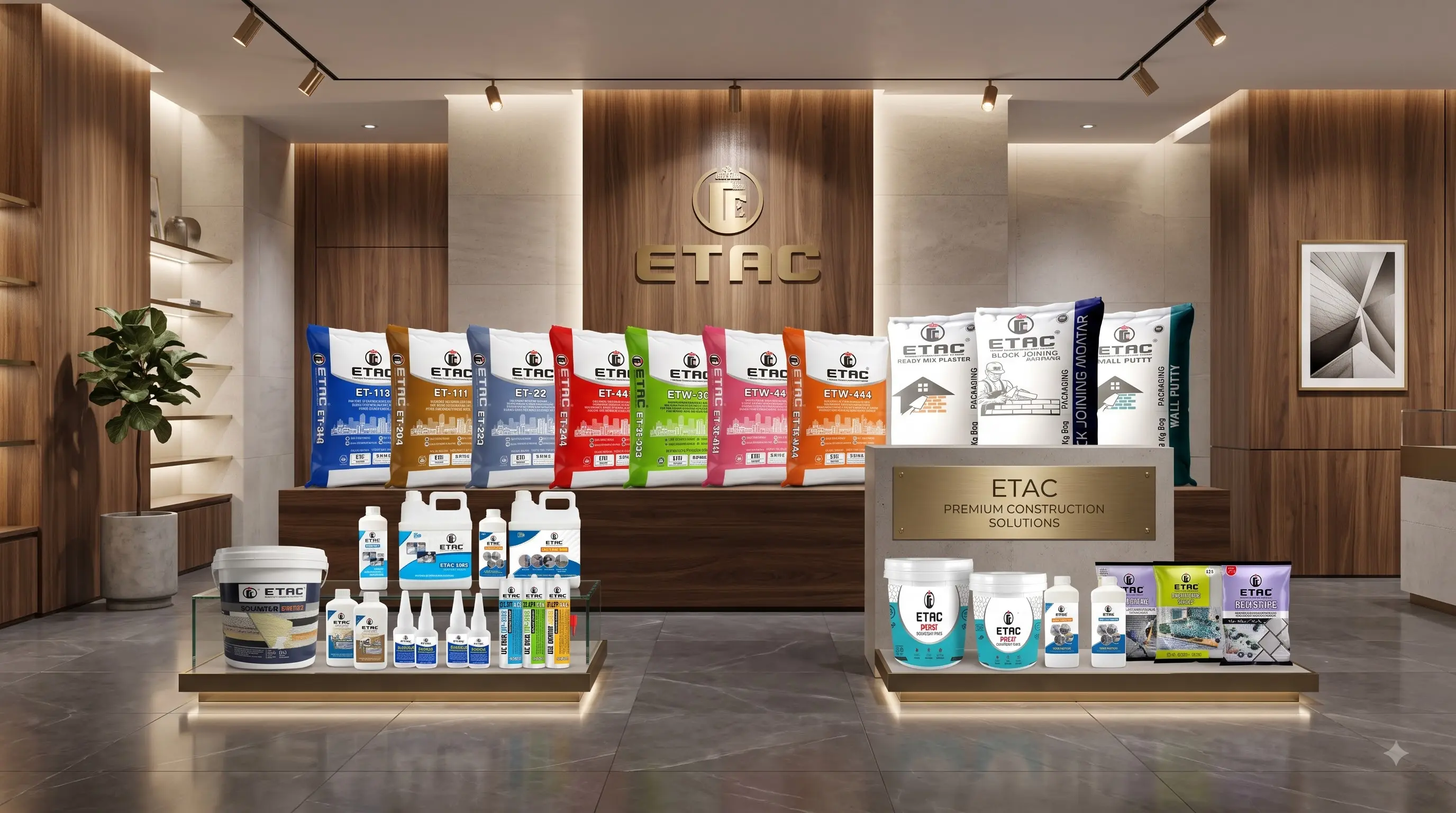
ETAC Construction Chemical develops construction chemical solutions designed to support modern construction and tile installation requirements.
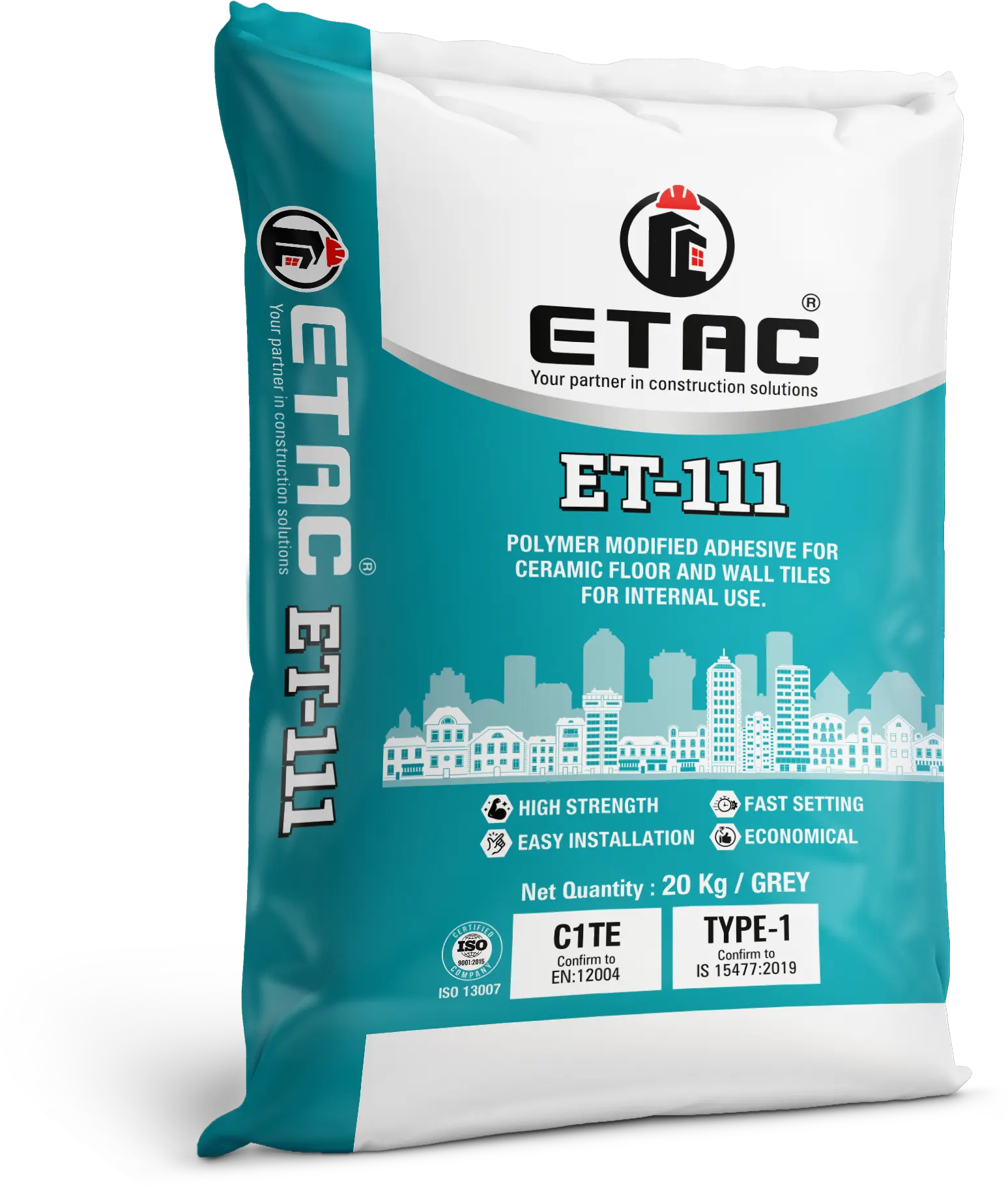
Our tile adhesive range is designed for different tile types, substrates and applications. Depending on the product specification, ETAC tile adhesives can provide solutions for ceramic and other tile installation requirements, including applications where reliable adhesion and controlled installation performance are important.
When selecting an ETAC tile adhesive, consider:
- Tile type
- Tile size
- Substrate
- Interior or exterior application
- Floor or wall installation
- Environmental conditions
- Required performance characteristics
ETAC Recommendation:
For the best results, always refer to the individual ETAC product's technical data sheet, recommended applications, mixing instructions, coverage and application guidelines before use.
Frequently Asked Questions
Which tile adhesive is best for vitrified tiles?
There is no single adhesive that is best for every vitrified tile installation. The correct adhesive depends on the tile, size, substrate, location and service conditions. Select a product specifically recommended for the intended application.
Can tile adhesive be used for vitrified tiles?
Yes. Suitable tile adhesives are available for vitrified and other low-porosity tiles. However, the adhesive should be specifically recommended for the tile and installation conditions.
Which adhesive is suitable for large-format tiles?
Large-format tiles generally require careful adhesive selection and installation to achieve adequate coverage. Depending on the application, a higher-performance or deformable adhesive may be appropriate. Always follow the manufacturer's technical recommendations.
Is back-buttering necessary for large-format tiles?
Back-buttering may be recommended for large-format tiles to help achieve appropriate adhesive coverage. The exact installation method should follow the tile and adhesive manufacturer's recommendations.
Can I use cement instead of tile adhesive for vitrified tiles?
Traditional cement-based fixing methods and modern tile adhesive systems are different installation approaches. For vitrified tiles, the selected fixing system should be appropriate for the tile, substrate and intended application.
How much tile adhesive is required per square foot?
Adhesive consumption varies depending on tile size, substrate flatness, trowel notch, adhesive thickness, application technique and whether back-buttering is used. Always refer to the coverage information provided in the relevant product technical data sheet.
Can tile adhesive be used for outdoor applications?
Some tile adhesives are specifically designed for exterior applications, while others may be intended only for interior use. Always check the product's recommended application before using it outdoors.
Final Thoughts
Choosing the right tile adhesive is an important part of achieving a durable and professional tile installation. For vitrified and large-format tiles, factors such as tile type, tile size, substrate, application location, adhesive classification and installation technique should all be considered before starting the work.
A quality adhesive alone is not enough. Proper surface preparation, correct mixing, appropriate trowel selection, adequate adhesive coverage, correct tile placement and proper curing are all essential parts of a successful installation.
At ETAC Construction Chemical, we focus on developing reliable construction chemical solutions for modern building and renovation requirements. By selecting the appropriate ETAC tile adhesive for your specific application and following the recommended installation procedure, contractors, tile installers, and construction professionals can work toward stronger, more reliable, and long-lasting tile installations.
Choose the Right Adhesive. Install It Correctly. Build with Confidence.
— ETAC Construction Chemical
Strong Bond. Lasting Finish.
pchejara
Verified Technical AdvisorySenior Construction Chemical Specialist at ETAC®. Advising contractors, applicators, and site engineers across India on tile adhesives, epoxy grouts, and waterproofing systems.
Ask Technical Specialist on WhatsApp →Need Tile Adhesives or Technical Support?
Explore our full range of high-grade polymers, tile adhesives, epoxy grouts, and waterproofing chemicals manufactured at Navsari, Gujarat.