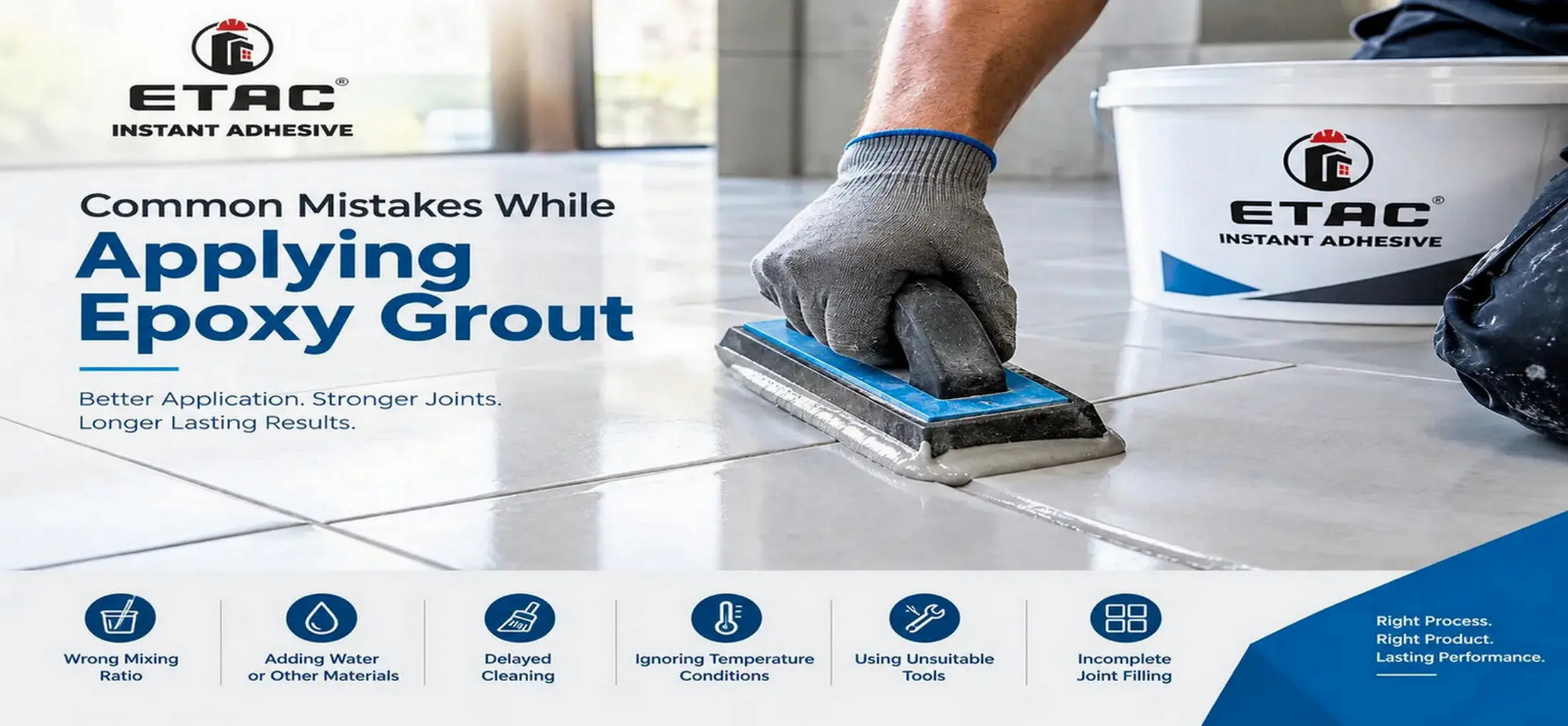
Epoxy grout can deliver excellent durability and a clean, long-lasting tile finish when applied correctly. However, incorrect mixing, poor joint preparation, incomplete filling, delayed cleaning, excessive water, unsuitable tools, and ignoring pot life or curing requirements can affect the final result. This guide from ETAC Construction Chemicals explains the most common epoxy grout application mistakes and practical ways to avoid them.
Common Mistakes While Applying Epoxy Grout
Epoxy grout is widely used in modern tile installations because of its excellent durability, chemical resistance, stain resistance, and low water absorption. It is particularly suitable for bathrooms, kitchens, commercial spaces, swimming pools, hospitals, industrial areas, and other locations where conventional cement-based grout may not provide the required performance.
However, even a high-performance epoxy grout can deliver unsatisfactory results when it is mixed, applied, or cleaned incorrectly. Common application mistakes can lead to problems such as sticky grout, uneven joints, surface haze, discoloration, poor finishing, and difficult cleaning.
At ETAC Construction Chemicals, we understand that successful tile installation depends not only on selecting the right product but also on following the correct application procedure. This article highlights the most common mistakes while applying epoxy grout and explains how contractors and applicators can avoid them.
1. Incorrect Mixing Ratio
One of the most critical mistakes when working with epoxy grout is using an incorrect proportion of the components. Epoxy grout generally consists of resin and hardener, and some systems may contain additional components.
Adding too much or too little of any component can affect the chemical reaction required for proper curing. This may result in soft grout, tackiness, reduced strength, poor chemical resistance, or inconsistent performance.
ETAC Recommendation: Always follow the mixing ratio specified in the product's Technical Data Sheet (TDS). Do not estimate the quantities manually.
2. Inadequate Mixing
Simply combining the components is not enough. Epoxy grout must be mixed thoroughly so that the resin and hardener are uniformly distributed throughout the material.
Incomplete mixing can create areas with different curing characteristics and may result in inconsistent colour, soft spots, or partially uncured material. Use clean mixing equipment and follow the manufacturer's recommended mixing method and mixing time.
3. Adding Water or Other Materials to the Epoxy Grout
Epoxy grout should not be diluted by adding extra water, cement, solvents, or other materials unless specifically permitted by the manufacturer. Such modifications can alter the formulation and negatively affect curing, adhesion, strength, colour, and chemical resistance.
Best Practice: Use the product exactly as supplied and follow the manufacturer's instructions.
4. Poor Surface and Joint Preparation
Before applying epoxy grout, tile joints should be properly prepared. Dust, loose particles, cement residue, adhesive residue, standing water, oil, or other contaminants can interfere with the application and finishing process.
Joints should be sufficiently clean and free from materials that could prevent the grout from properly filling the joint. A clean and properly prepared surface is an essential part of achieving a consistent and professional finish.
5. Applying Too Much Grout
Overfilling the joints can leave excessive epoxy material on the tile surface. This can make cleaning more difficult and increase the possibility of epoxy residue or haze after curing.
The grout should be worked firmly into the joints using an appropriate grout float or recommended application tool. Excess material should be removed from the tile surface while the product is still within its workable cleaning period.
6. Delaying the Cleaning Process
One of the most common causes of poor epoxy grout finishing is delayed cleaning. Unlike conventional cement grout, cured epoxy residue can be considerably more difficult to remove. If excess material is allowed to remain on the tile surface for too long, it can harden and create an unwanted film or haze.
ETAC Recommendation: Begin the cleaning process according to the product's recommended working and cleaning time. Do not wait until the entire area has been grouted before starting the cleaning process.
7. Using Excessive Water During Cleaning
Water is commonly used as part of epoxy grout cleaning, but excessive water or improper cleaning techniques can negatively affect the appearance of freshly installed joints. Use the recommended amount of water and suitable cleaning tools. Cleaning should be performed systematically, ensuring that excess grout is removed without disturbing the joints.
8. Ignoring Temperature and Environmental Conditions
Temperature can significantly influence the working time and curing behaviour of epoxy grout. Higher temperatures can shorten the available working time, while lower temperatures may slow the curing process.
Before beginning installation, contractors should check the application temperature requirements mentioned in the product's technical documentation. Proper planning is especially important for large projects and installations exposed to changing site conditions.
9. Using Contaminated Tools
Dirty tools can introduce dust, old grout, or other contaminants into the fresh epoxy material. This can affect the appearance and consistency of the finished joints. Always use clean tools and suitable application equipment. Tools should also be maintained and cleaned according to the manufacturer's recommendations throughout the application process.
10. Not Conducting a Trial Application
Different tile surfaces can react differently to epoxy grout. Highly textured, porous, matte, or difficult-to-clean tiles may require additional care during application and cleaning.
Conducting a small trial area before beginning large-scale work can help determine the most suitable application and cleaning technique. A trial application can also help the applicator evaluate the final colour, finish, cleaning process, and compatibility with the tile surface.
11. Ignoring the Recommended Working Time
Epoxy grout has a limited working time after its components are mixed. Trying to use material beyond its recommended working period can make application and finishing increasingly difficult. For large installations, plan the work in manageable sections so that the material can be properly applied and cleaned within the recommended time.
12. Allowing Premature Traffic
Freshly applied epoxy grout needs sufficient time to cure before the tiled area is subjected to heavy traffic, water exposure, or regular use. Allowing premature traffic or exposing the installation to water before the recommended curing period can affect the final performance of the grout. Always follow the manufacturer's stated curing and service requirements before opening the area for use.
How to Achieve Better Epoxy Grouting Results
A successful epoxy grout installation depends on a combination of the right product, proper preparation, skilled application, and appropriate cleaning. Contractors should follow these basic principles:
- Read the product Technical Data Sheet before starting work.
- Use the specified mixing ratio.
- Mix the components thoroughly and uniformly.
- Prepare the tile joints properly.
- Use clean and appropriate application tools.
- Work within the recommended pot life and working time.
- Remove excess grout promptly using the recommended cleaning procedure.
- Maintain suitable temperature and site conditions.
- Carry out a trial application when working with unfamiliar tile surfaces.
- Allow the grout to cure for the recommended period before service.
ETAC Construction Chemicals: Focused on Reliable Tile Installation
At ETAC Construction Chemicals, we recognize that the performance of a tile installation depends on both material quality and correct application practices. Epoxy grout can provide excellent durability and resistance when it is selected appropriately and installed according to the manufacturer's recommendations.
By avoiding common application mistakes, contractors and applicators can achieve better joint filling, cleaner finishes, improved durability, and more consistent results across residential, commercial, and industrial projects.
Final Thoughts
Epoxy grout is a high-performance grouting solution, but its benefits can only be fully achieved when the product is handled correctly. Incorrect mixing, poor joint preparation, delayed cleaning, unsuitable site conditions, and premature use are some of the common mistakes that can compromise the finished installation.
For professional results, always follow the product-specific instructions, use suitable application techniques, and pay close attention to the recommended mixing, working, cleaning, and curing times.
ETAC Construction Chemicals remains committed to supporting quality construction practices by providing reliable construction chemical solutions and technical guidance for modern tile installation requirements.
pchejara
Verified Technical AdvisorySenior Construction Chemical Specialist at ETAC®. Advising contractors, applicators, and site engineers across India on tile adhesives, epoxy grouts, and waterproofing systems.
Ask Technical Specialist on WhatsApp →Need Tile Adhesives or Technical Support?
Explore our full range of high-grade polymers, tile adhesives, epoxy grouts, and waterproofing chemicals manufactured at Navsari, Gujarat.