7 Tile Adhesive Failures We Commonly See on Construction Sites in India | ETAC Construction Chemical
Discover 7 common tile adhesive failures frequently seen on construction sites in India, including tile debonding, hollow tiles, poor surface preparation, incorrect mixing, and adhesive skinning. Learn their causes, warning signs, and practical prevention methods for long-lasting tile installation.
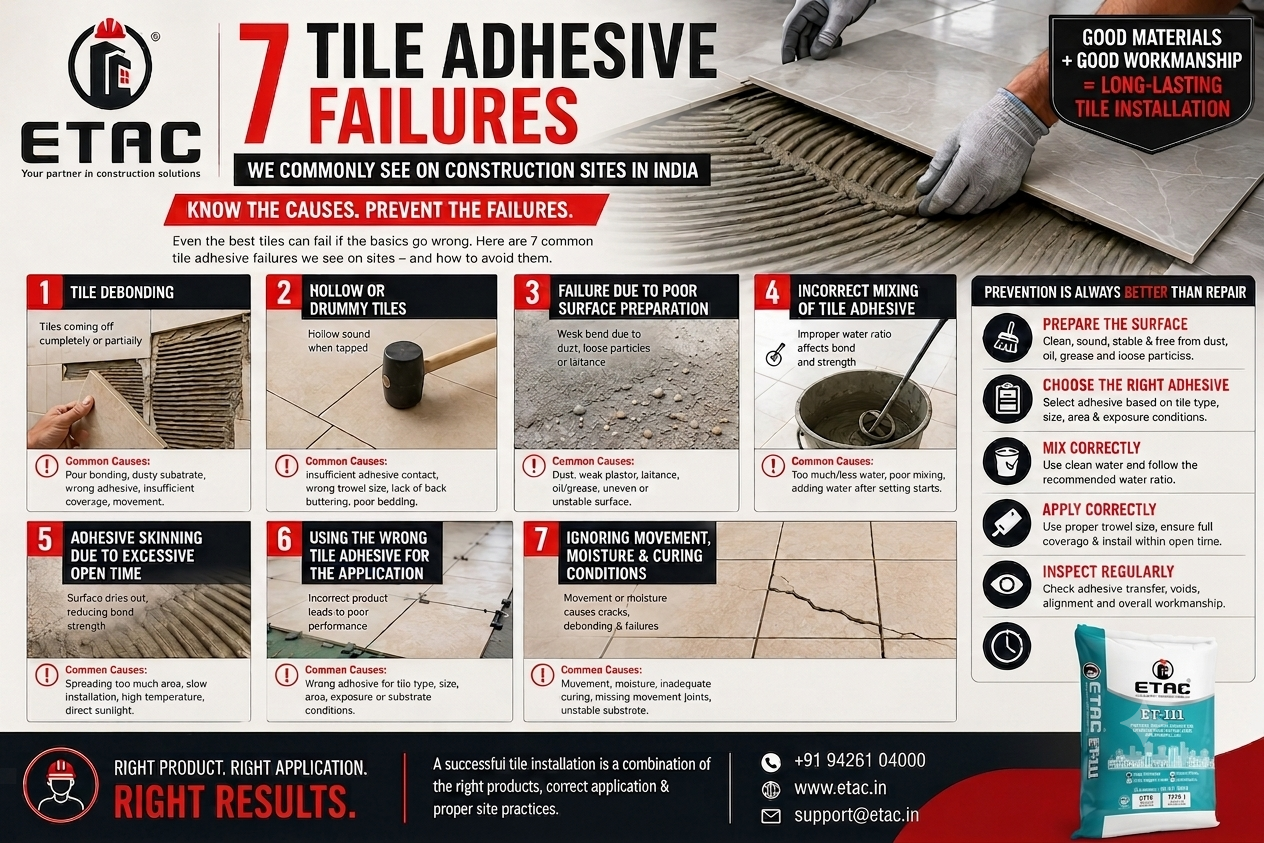
7 Tile Adhesive Failures We Commonly See on Construction Sites in India
Tile installation failures can be frustrating, expensive, and sometimes dangerous. A beautifully tiled floor or wall may initially appear perfect, only to develop hollow sounds, cracks, loose tiles, or complete tile debonding months later.
In many cases, people immediately blame the tile adhesive. However, tile installation is a complete system. The final performance depends on substrate preparation, adhesive selection, mixing, application technique, adhesive coverage, environmental conditions, and curing.
At ETAC Construction Chemicals, we believe that understanding the cause of a failure is the first step toward preventing it.
Here are seven common tile adhesive failures frequently encountered on construction sites in India and, more importantly, how to prevent them.
1. Tile Debonding – When Tiles Start Coming Off
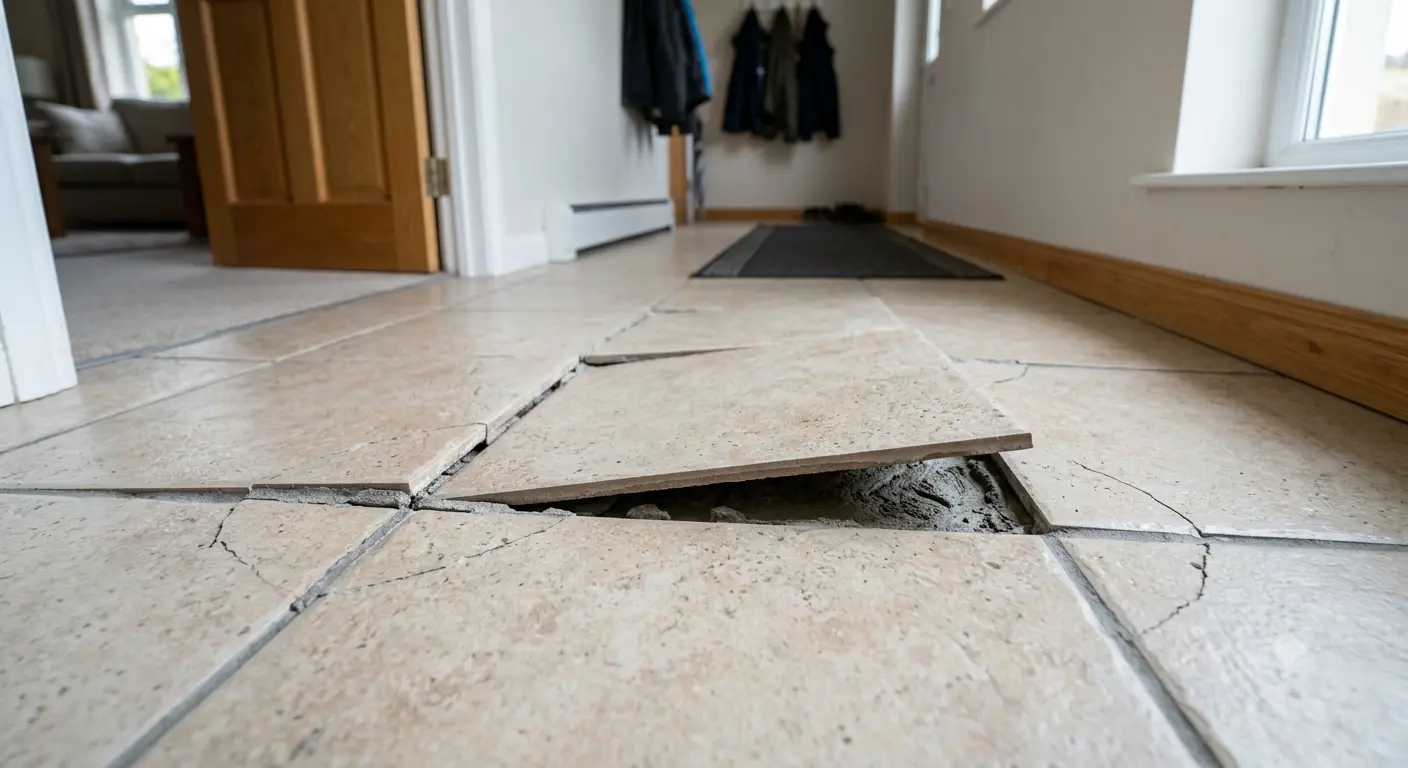
One of the most serious tile installation failures is tile debonding. A tile may partially loosen, lift from the corners, or completely separate from the wall or floor.
Common Symptoms
- Tiles falling from walls
- Corners lifting
- Loose tiles
- Cracks appearing around grout joints
- Tiles separating cleanly from the substrate
Common Causes
Tile debonding can occur due to:
- Dusty or weak substrates
- Incorrect adhesive selection
- Poor adhesive mixing
- Insufficient adhesive coverage
- Applying adhesive over an unsuitable surface
- Installing tiles after the adhesive has started skinning
- Excessive moisture or substrate movement
How to Prevent It
Before installation, always inspect the substrate. The surface should be clean, sound, structurally stable, and free from loose particles, oil, grease, and dust.
Most importantly, select the tile adhesive according to the tile type, size, application area, and exposure conditions.
A small ceramic wall tile in a dry indoor area does not have the same adhesive requirements as a large-format vitrified tile installed on an exterior wall.
ETAC Construction Chemical Tip: Before starting a large installation, perform a small trial application and inspect the adhesive transfer to the back of the tile. This simple check can reveal application problems before hundreds of tiles are installed.
2. Hollow or Drummy Tiles
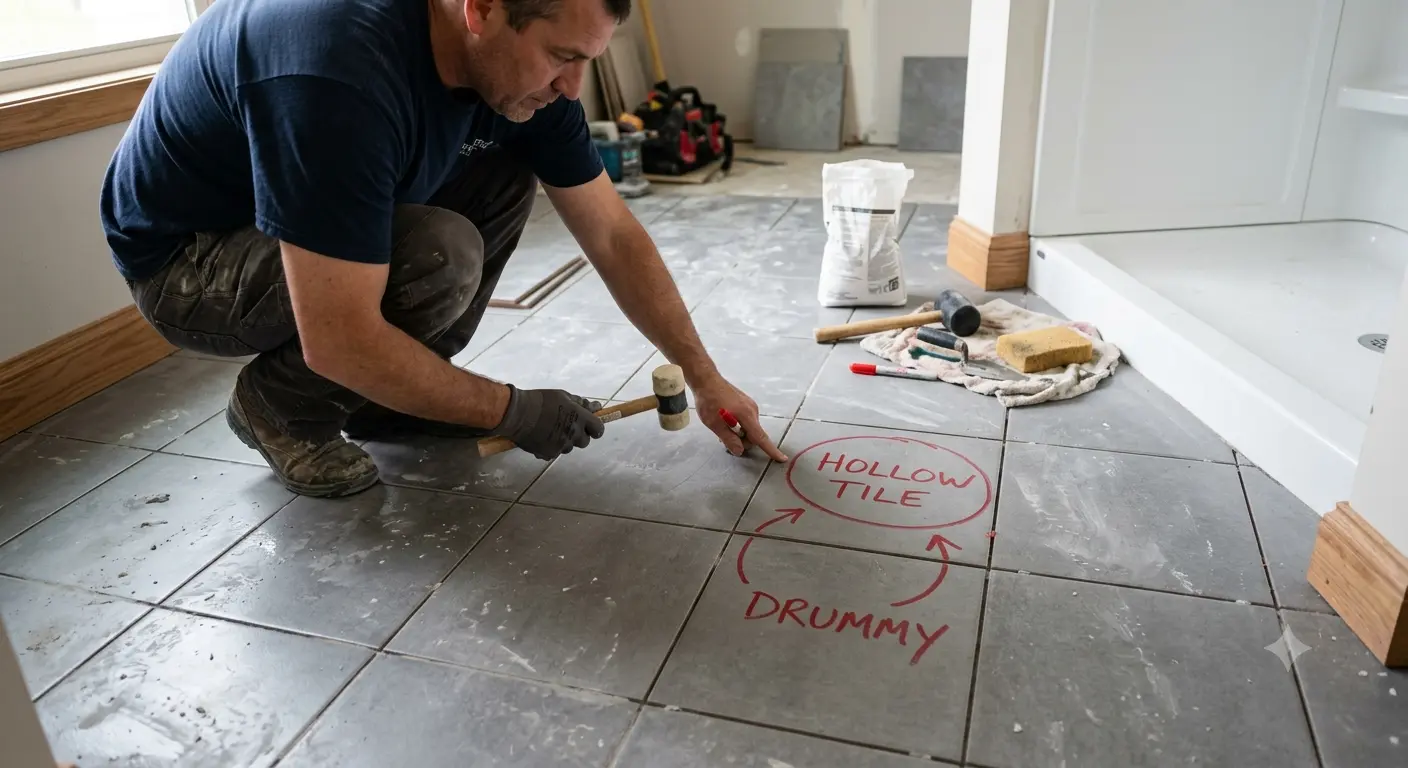
Have you ever tapped a tile with a coin or hard object and heard a hollow sound?
This is commonly referred to as a hollow or drummy tile. While not every hollow sound immediately means the tile will fail, significant voids beneath tiles can create weak points that may eventually lead to cracking or debonding.
Common Symptoms
- Hollow sound when tapping
- Cracked tiles under load
- Loose corners
- Grout cracking
- Uneven support beneath tiles
Why Does It Happen?
The most common reason is insufficient adhesive contact between the tile and substrate. This can happen when:
- The wrong notched trowel is used
- Adhesive is applied unevenly
- Tiles are not properly pressed into the adhesive
- Large-format tiles are installed without back buttering
- Adhesive ridges are not properly collapsed
- Air pockets remain beneath the tile
How to Prevent It
Use the correct notched trowel based on the tile size and application. Apply the adhesive consistently and comb it in one direction.
After placing the tile, press and move it slightly to help collapse the adhesive ridges and improve contact.
For large-format tiles, back buttering may be necessary to improve adhesive coverage and reduce voids.
Practical Site Check: Periodically lift a freshly installed tile and inspect the adhesive transfer. If large areas of the tile back remain uncovered, the application technique should be corrected immediately.
3. Failure Caused by Poor Surface Preparation
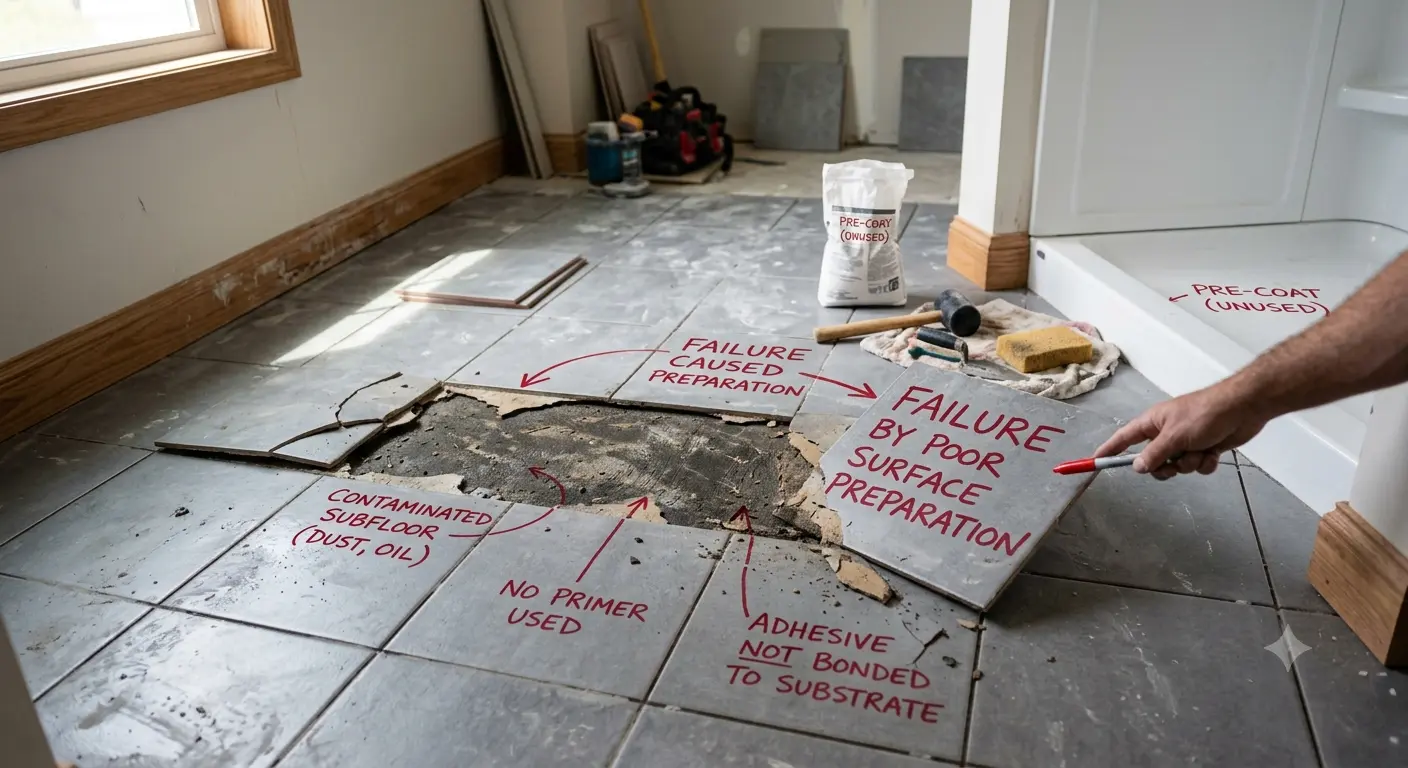
Tile adhesive can only bond as effectively as the surface beneath it. One of the biggest mistakes on construction sites is assuming that a premium adhesive can compensate for a poor substrate.
It cannot.
Common Substrate Problems
- Construction dust
- Loose plaster
- Weak screed
- Cement laitance
- Oil or grease contamination
- Paint residue
- Uneven surfaces
- Existing hollow tiles
- Excessive moisture problems
When adhesive is applied over dust or weak material, it may bond to that weak layer instead of the structural substrate.
Eventually, the entire system can fail.
Example
Imagine applying adhesive to a dusty concrete floor. The adhesive may initially appear to stick properly. However, the actual bond may be between the adhesive and the dust layer—not between the adhesive and the concrete.
Over time, stress, moisture, vibration, or thermal movement can cause separation.
How to Prevent It
- Remove loose material.
- Clean dust and debris.
- Repair weak areas.
- Correct significant unevenness.
- Check substrate stability.
- Address moisture issues where necessary.
ETAC Recommendation: Never treat surface preparation as an optional step. A properly prepared substrate is one of the foundations of a successful tile installation.
4. Incorrect Mixing of Tile Adhesive
Tile adhesive is formulated with a carefully balanced combination of cement, graded aggregates, polymers, and performance additives.
Adding too much or too little water can affect its workability and performance.
Unfortunately, one common site practice is adding extra water simply to make the adhesive easier to spread. This shortcut can create long-term problems.
Common Mixing Mistakes
- Adding excess water
- Using insufficient water
- Mixing manually without achieving uniform consistency
- Not allowing the material to rest when required
- Adding additional water after the adhesive starts setting
- Preparing more material than can be used within its working time
What Can Happen?
- Reduced bonding performance
- Poor workability
- Inconsistent adhesive consistency
- Increased shrinkage
- Difficulty achieving proper coverage
How to Prevent It
Always follow the manufacturer's recommended water ratio.
Use clean water and proper mechanical mixing where recommended. Prepare only the quantity that can realistically be used within the product's working time.
Once the material begins to set, avoid attempting to restore workability by simply adding more water.
Important Principle: Do not change the formulation of the adhesive at the construction site. The product has already been engineered for performance.
5. Adhesive Skinning Due to Excessive Open Time
This failure is especially important on busy construction sites and during hot weather.
An installer may spread adhesive over a large area to work faster. However, if tiles are not placed within the appropriate open time, the surface of the adhesive can begin to dry or form a skin.
The adhesive underneath may still appear soft, but the surface may no longer transfer properly to the back of the tile.
Common Signs
- Poor adhesive transfer
- Tiles appearing bonded initially but loosening later
- Reduced contact between tile and adhesive
- Hollow areas
Why Does This Happen?
- Spreading adhesive over too large an area
- Slow installation
- High temperatures
- Strong airflow
- Direct sunlight
- Delays between combing adhesive and placing tiles
Indian construction sites can experience challenging environmental conditions, particularly during hot and dry periods.
How to Prevent It
Apply adhesive in manageable sections. Do not spread more adhesive than can be tiled within the recommended working period.
If the adhesive surface has dried or skinned, do not simply place the tile on top. Remove the affected material and apply fresh adhesive.
ETAC Site Practice: Rather than asking "How much area can we cover quickly?", ask "How much area can we tile correctly before the adhesive surface loses its bonding capability?"
6. Using the Wrong Tile Adhesive for the Application
Not all tiles are the same. Modern construction increasingly uses different types of tiles, including vitrified tiles, porcelain tiles, large-format tiles, glass mosaic tiles, natural stone, and heavy wall tiles.
Each application may have different performance requirements.
A common mistake is selecting adhesive based only on price rather than technical suitability.
Common Examples of Incorrect Selection
- Using basic adhesive for large-format tiles
- Using indoor adhesive for exterior applications
- Using unsuitable adhesive in permanently wet areas
- Using a lower-performance adhesive for dense, low-absorption tiles
- Using the same adhesive for every application without considering site conditions
How to Prevent It
Before selecting tile adhesive, evaluate the complete installation requirements.
| Factor | Question to Ask |
|---|---|
| Tile Type | Ceramic, vitrified, porcelain, or natural stone? |
| Tile Size | Small, medium, or large format? |
| Application Area | Wall, floor, interior, or exterior? |
| Environment | Dry area, wet area, or swimming pool? |
| Substrate | Concrete, plaster, screed, or existing tile? |
| Exposure | Thermal movement, water exposure, or heavy traffic? |
The correct adhesive should be selected based on the complete application—not simply the tile's appearance.
7. Ignoring Movement, Moisture, and Curing Conditions
Sometimes the adhesive is correctly selected and properly applied, but the installation still develops problems.
Why?
Because tile installation does not exist independently from the building structure.
Buildings move. Concrete shrinks. Temperatures change. Moisture travels through building materials. These factors can create stress within a tiled surface.
Common Problems
- Thermal expansion
- Structural movement
- Substrate shrinkage
- Moisture-related stress
- Inadequate curing
- Missing movement joints
- Tiling over unstable substrates
Common Failure Symptoms
- Cracked tiles
- Cracked grout lines
- Edge lifting
- Tile debonding
- Repeated failures in the same area
Areas That Require Extra Attention
- Exterior walls
- Terraces
- Balconies
- Swimming pools
- Bathrooms
- Commercial floors
- Large tiled areas
How to Prevent It
Do not treat tile adhesive as a solution for structural problems.
Before tiling:
- Check substrate condition.
- Allow appropriate curing.
- Address moisture problems.
- Plan movement joints where required.
- Select suitable products for the environment.
A successful tile installation requires coordination between substrate preparation, waterproofing, adhesive selection, installation technique, and finishing.
Quick Diagnosis Guide: What Is Your Tile Problem?
| Problem | Possible Cause |
|---|---|
| Tile falling off | Poor bonding, wrong adhesive, or weak substrate |
| Hollow sound | Insufficient adhesive coverage or air voids |
| Tile cracking | Hollow areas, movement, or uneven support |
| Corner lifting | Poor coverage or inadequate bonding |
| Grout cracking | Substrate movement or tile movement |
| Tiles loosening after months | Incorrect adhesive selection or installation issues |
| Exterior tile failure | Thermal movement or unsuitable adhesive system |
The Biggest Lesson: Tile Adhesive Is Only One Part of the System
When a tile installation fails, the easiest response is to blame the adhesive. However, a professional investigation should ask several questions:
- Was the substrate properly prepared?
- Was the correct adhesive selected?
- Was the mixing ratio correct?
- Was the adhesive applied within its working time?
- Was sufficient coverage achieved?
- Was the tile properly bedded?
- Were environmental conditions considered?
- Was the substrate stable?
The answer is often found in the complete installation process.
ETAC's Recommended Site Checklist Before Tile Installation
Substrate
- ✓ Clean and free from dust
- ✓ Structurally sound
- ✓ Properly cured
- ✓ Level and stable
- ✓ Free from loose particles
Adhesive Selection
- ✓ Suitable for tile type
- ✓ Suitable for tile size
- ✓ Suitable for interior or exterior use
- ✓ Suitable for wet or dry conditions
Application
- ✓ Correct water ratio
- ✓ Proper mixing
- ✓ Correct notched trowel
- ✓ Consistent adhesive coverage
- ✓ Tiles installed within open time
Quality Check
- ✓ Periodically inspect adhesive transfer
- ✓ Check for voids
- ✓ Check tile alignment
- ✓ Allow appropriate curing
Final Thoughts
Most tile adhesive failures are preventable. The key is to stop viewing tile installation as simply:
Apply Adhesive → Fix Tile → Finish.
Professional tile installation requires a systematic approach.
From substrate inspection and adhesive selection to mixing, troweling, coverage, and curing, every step contributes to long-term performance.
For contractors, builders, architects, and homeowners, understanding these common failures can help prevent costly repairs and improve the durability of tiled surfaces.
At ETAC Construction Chemicals, we believe that the right product must always be supported by the right application practice.
Because when it comes to tile installation, good materials and good workmanship must work together.
Frequently Asked Questions
1. Why do tiles sound hollow after installation?
Tiles may sound hollow when there are voids or insufficient adhesive coverage beneath them. Incorrect troweling, uneven adhesive application, and inadequate bedding can contribute to this issue.
2. Why do tiles fall off walls?
Tiles can fall due to poor substrate preparation, incorrect adhesive selection, inadequate bonding, insufficient coverage, moisture problems, or installation errors.
3. Can adding more water improve tile adhesive workability?
Adding more water than the manufacturer's recommended ratio may affect adhesive performance. Always follow the recommended mixing instructions.
4. Why is surface preparation important before tile installation?
Tile adhesive needs a clean, strong, stable surface to achieve proper bonding. Dust, loose particles, grease, and weak plaster can significantly reduce bond performance.
5. Should large-format tiles receive special attention?
Yes. Large-format tiles require careful substrate preparation, appropriate adhesive selection, proper trowel technique, and sufficient adhesive coverage.
6. Can hot weather affect tile adhesive installation?
Yes. High temperatures and strong airflow can reduce the available working or open time. Installers should work in manageable sections and follow the product's application instructions.
Need Help Choosing the Right Tile Adhesive?
Every project has different requirements. Tile size, substrate condition, application area, and environmental exposure should all be considered before selecting an adhesive.
Contact ETAC Construction Chemicals for product guidance and technical support for your tile installation requirements.
pchejara
Verified Technical AdvisorySenior Construction Chemical Specialist at ETAC®. Advising contractors, applicators, and site engineers across India on tile adhesives, epoxy grouts, and waterproofing systems.
Ask Technical Specialist on WhatsApp →Need Tile Adhesives or Technical Support?
Explore our full range of high-grade polymers, tile adhesives, epoxy grouts, and waterproofing chemicals manufactured at Navsari, Gujarat.